
The Achilles Heel
This guide is for you if you just purchased your E46 or have more than 75,000 miles on your current cooling system. The E46 3-Series is known to have a delicate cooling system which often fails prematurely. In the event of a failure, the results are catastrophic. The inherent design of the inline-six BMW engine having a long block/head coupled with the fact that the head is made of aluminum means that it is particularly vulnerable to heat damage (or warp). This damage to the head and headgasket can occur in seconds once your car is overheated and usually means a top-end rebuild which may cost around $2,500 to repair.
This exact guide, the part numbers, and the pricing apply specifically to the 6-Cylinder Petrol Engines (M52TU / M54) found in the 320i, 323i, 325i, 328i, and 330i/ci.
Diesel owners (M47/M57) and 4-cylinder owners: While the principles of failing plastics remain identical, your specific part numbers, layouts, and thermostats (e.g., EGR thermostat on diesels) are completely different.
If your temperature gauge does go into the red zone, IMMEDIATELY shut off the car and have it towed. Do not attempt to drive it.
Plastics: The Expansion Tank & Radiator
Your E46 contains lots of plastic. The typical first failure is the expansion tank. It will typically develop a hairline crack anywhere from 60-95k miles. That crack will expand under heat and water will leak out, tripping the low coolant warning on your dash. If this level becomes low enough, there will not be enough coolant for the water pump to circulate. No circulation means overheating.
The radiator is typically robust, but the endtanks are made of plastic. The rubber seal between the endtanks and the main body may deteriorate, leading to staining or slight weeping. The radiator also has thin passages which can become clogged with sediments, causing water to flow slowly and leading to overheating in traffic.
Pulleys and Belt Systems
The main belt drives the water pump, alternator, and power steering pump, guided by pulleys containing ball bearings and grease. After around 60k miles, this grease dries up and the pulleys are vulnerable to failure. When a pulley fails, the belts are thrown off. You now have no cooling system, no power steering, and no charging system. Your dashboard will light up like a christmas tree and your temp needle will fly into the redzone. Belts are self-explanatory: replace them every 35k miles.
The Water Pump & Thermostat
The water pump can fail in at least three ways: 1) The impeller itself will break, 2) The seal may leak, 3) The bearings will fail causing the shaft to wobble and break. Replace your water pump due to age and/or mileage, not because of what it’s made out of. The latest BMW OEM design features a plastic composite impeller (BMW phased out metal impellers due to premature bearing failures). Design is more important than physical materials.
The thermostat sometimes fails around the time the expansion tank does. They are generally designed to fail stuck open, but don’t risk it. Just change it.
Automatic Transmissions: Fan Blade & Clutch
If your car has an automatic transmission, it is equipped with a mechanical fan. If the plastic fan blade chips or deteriorates, it loses its balance and will explode in your engine bay at high RPMs. It will take out your belts, hoses, hood, and whatever else it feels like. The fan clutch controls the speed of this fan; while robust, it is good practice to replace it so it doesn’t spin too slowly or too quickly.
The Master Parts List
Below is the complete parts list required for a full overhaul. Trusted vendors include BMAparts.com, RMEuropean.com, and OEMbimmerparts.com.
Disclaimer: Prices are historical references to show the estimated cost of a proper OEM refresh. Euro (€) conversions are approximate estimations.
Automatic Transmission Additions
Required Tools & Torque Specs
Do not attempt this job without the correct tools, especially if you have an automatic transmission. You will get stuck.
The Tear-Down Guide
Mechanic’s Notes & Pitfalls
- Lubricate the O-Rings: Use a tiny bit of silicone paste or coolant on the inner O-rings of the new hoses before pushing them on. Dry rubber will tear.
- The Expansion Tank Bracket: The plastic bracket under the tank is notoriously brittle. Pull straight up firmly but carefully to avoid snapping it.
- Fan Clutch Thread: Remember that the mechanical fan clutch (on autos) is reverse-threaded. Turn clockwise to loosen!
- Do Not Overtighten: The water pump and thermostat bolts tap directly into the aluminum engine block. Stick to the 10 Nm torque spec or you will strip the threads.
Bleeding The System: VERY IMPORTANT
This step is extremely important. No amount of brand new cooling parts will work if you do not bleed. The point is to remove air bubbles. CAUTION: ONLY DO THIS WHEN CAR IS COOL AND ENGINE IS OFF.
- Raise front of car on ramps (Not necessary, but recommended).
- Remove expansion tank cap and bleed screw and set aside.
- Turn ignition to ON (dash lights on but do NOT start the car).
- Set heat to MAXIMUM (90°F / 32°C) and fan speed to low (this opens heater valve).
- Begin to fill your expansion tank with a 50/50 mix of Genuine BMW coolant and distilled water (do not use anything else). The system might take a while to swallow the water. Massage the hoses if you think it will help. Keep pouring.
- Water will begin to pour out of the bleed screw hole with air bubbles. The point is to keep filling until the bubbles are gone. Be patient.
- Once a continual stream of bubble-free water is emerging from the bleed hole, replace the bleed screw (do not overtighten).
- The expansion tank will be full to the top at this point. Siphon off any excess so that the appropriate tank level is achieved.
Congratulations. Your E46 is now ready for another 75k miles of trouble-free driving. Never will you have to worry about posting a thread asking why your car is overheating.
The Cold Truth
Unlike their petrol counterparts that frequently overheat, the M47 and M57 diesel engines in the E46 (320d, 330d) usually suffer from the exact opposite problem: they run too cold. A failing thermostat on these engines will stay permanently open, preventing the engine from reaching its optimal 88°C (190°F) operating temperature. This ruins your fuel economy, clogs the EGR system with soot, increases engine wear, and prevents proper combustion.
This technical guide is specifically tailored for the M47 (4-Cylinder) and M57 (6-Cylinder) Turbo-Diesel engines. If you drive a petrol E46 (325i, 330i), please refer to our Petrol Cooling System guide, as your thermostats, water pumps, operating temperatures, and hose layouts are entirely different.
Never trust the temperature gauge on your cluster. BMW programmed a massive “buffer”: the needle points perfectly straight up at 12 o’clock anywhere between 75°C and 115°C. Your diesel could be running at a freezing 76°C (destroying MPG) and the needle will still look “normal”. You must unlock the hidden OBC menu (Test 7.0) to see the exact digital temperature in real-time.
1. The Main Thermostat (88°C)
The main thermostat is integrated into a plastic housing bolted to the front of the engine block. It is designed to open at exactly 88°C. Just like the EGR unit, it fails in the “open” position to save the engine from overheating, but punishes you with poor MPG and a heater that blows lukewarm air in winter. Replacing this on an M57 requires removing the EGR cooler and dropping the coolant level.
2. The EGR Thermostat (70°C)
E46 Diesels feature a secondary thermostat sitting on top of the EGR cooler, designed to open at 70°C to cool exhaust gases. This is notoriously fragile and fails open early in its life. Because coolant flows directly from the block through the EGR cooler, a failed EGR thermostat acts like a massive bypass, constantly cooling the engine even if the main thermostat is closed.
3. The “Ghost” Automatic Thermostat
If you have an Automatic Transmission, you have a third thermostat! It is located at the bottom of the expansion tank bracket, regulating coolant flow to the transmission heat exchanger. If you have replaced both the Main and EGR thermostats and your car still runs cold on the highway, this heat exchanger thermostat is the culprit. It fractures internally and flows constantly.
The “Radiator Sandwich”
The diesel front end packs an A/C condenser, an Intercooler, and the Radiator tightly together. Over 100k miles, dirt, leaves, and road grime form an impenetrable “wall” between these layers. Even with a brand new cooling system, this blockage prevents the viscous fan from pulling air through the fins. Whenever the radiator is out, split the intercooler and clean the fins!
The Diesel Overhaul Parts List
Below are the critical components for the M47/M57 cooling system. Stick to Behr/Mahle for thermostats and INA/Saleri for water pumps. Note: Always verify your exact part number via RealOEM using your VIN, as early (pre-LCI) and late (LCI) diesels have slight variations.
Disclaimer: Prices are historical references to show the estimated cost of a proper OEM refresh. Euro (€) conversions are approximate estimations.
Required Tools & Specs
The diesel engine bay is incredibly cramped at the front. Removing the EGR cooler and getting to the main thermostat requires patience and specific tools.
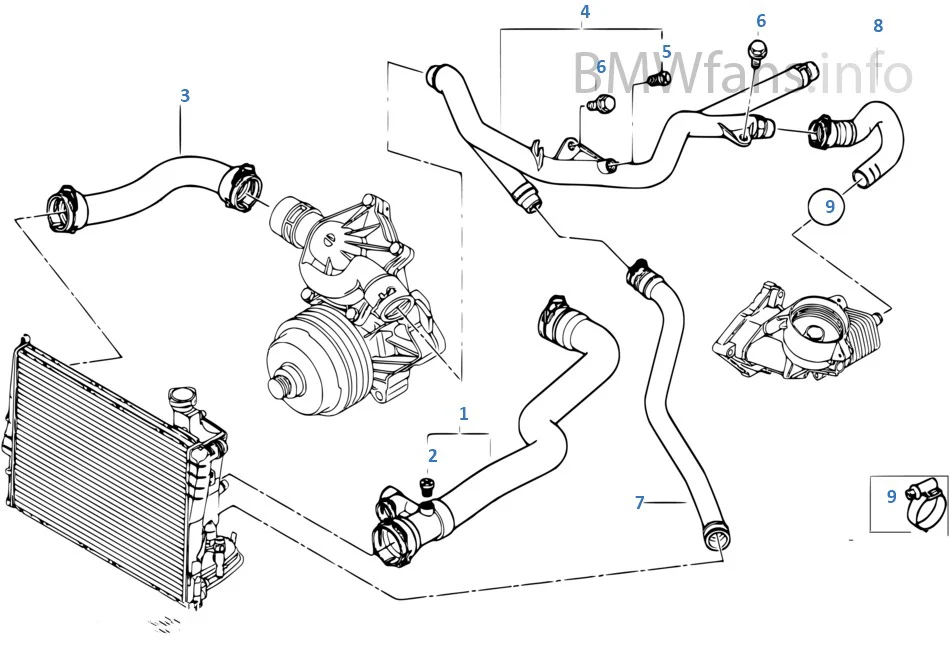
OEM M57 Cooling Schematic
Familiarize yourself with the routing before tearing down. Pay special attention to the EGR cooler flow and the location of the main thermostat housing on the block.
Master Mechanic’s Pitfalls
- The “Blow Test”: Before installing a new EGR thermostat (or to test your old one), try to blow air through it with your mouth. At room temperature, it should be completely sealed. If air passes through, the thermostat is defective right out of the box.
- Left-Hand Thread Warning: The 32mm nut holding the viscous fan clutch to the water pump is reverse-threaded. You must turn the wrench CLOCKWISE (towards the passenger side on LHD cars) to loosen it!
- The EGR Cooler Flange: The bolts holding the EGR cooler to the exhaust manifold endure extreme heat cycles. Soak them in penetrating oil (Kroil/WD-40) for hours before turning them, or they will snap inside the manifold.
- The Metal Water Pump Gasket: Unlike the M54 petrols that use a rubber O-ring, the M57 water pump uses a profiled metal gasket. Ensure the engine block mating surface is perfectly clean (use Scotch-Brite) before installing the new pump.
Bleeding The Diesel System
Diesels take much longer to warm up than petrol cars, making the bleeding process slightly more tedious. Pay attention to the specific bleed screw locations.
- With the engine OFF and cold, locate and open all bleed screws. On an M57, you typically have one on the EGR thermostat itself, one on the hard coolant return pipe (near the oil filter housing), and one on the expansion tank.
- Turn ignition ON (Position 2), set cabin heat to MAX (32°C) and the blower fan speed to Low. This opens the heater core valves.
- Slowly pour the 50/50 coolant mix into the expansion tank until bubble-free coolant emerges from the lowest bleed screw (usually the hard pipe). Close that screw gently (plastic threads strip easily!).
- Continue filling until coolant emerges from the EGR thermostat screw, and close it. Finally, close the expansion tank bleed screw.
- Start the engine and give it a few gentle revs to circulate the water pump. Monitor the coolant level and top up if the bobber drops.
- Take the car for a drive. Crucial Step: Because modern diesels are highly thermally efficient, idling will never get them hot. You must drive the car under load (highway speeds or uphill) to force the main thermostat to open fully (88°C) and purge the final air pockets into the expansion tank.
- Re-check the coolant level the next morning when the engine is dead cold.