
The Carbon Fiber
Masterpiece.
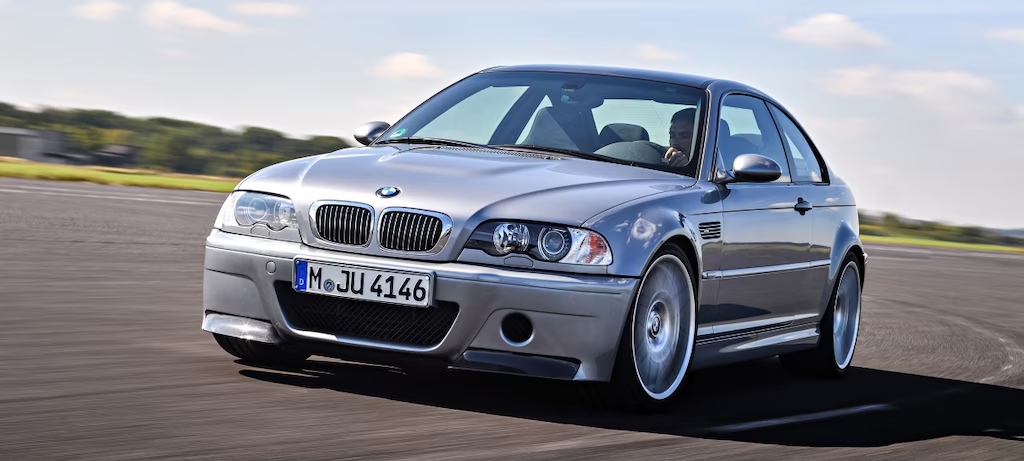
CSL. Three letters that stand for Coupé Sport Leichtbau (Coupe Sport Lightweight). Three letters that give every driving enthusiast goosebumps.
When BMW M introduced the M3 CSL in 2003, they didn’t just create a special edition; they birthed an automotive icon. The objective was simple but grueling: take the already brilliant E46 M3 and subject it to a ruthless motorsport diet, extracting every last ounce of performance to conquer the Nürburgring Nordschleife. Limited to just 1,383 units worldwide and available only in Silver Grey Metallic or Black Sapphire Metallic, the CSL remains the crowning achievement of the analog BMW M era.
Intelligent Lightweight Construction
Lightweight construction wasn’t just a marketing buzzword for the CSL; it was a total engineering philosophy. BMW M engineers managed to shave an impressive 110 kilograms (242 lbs) off the standard M3, bringing the curb weight down to a lean 1,385 kg (3,053 lbs).
This extreme diet was achieved through the pioneering use of advanced materials:
- The Carbon Fiber Roof: The M3 CSL was the first BMW M production car to feature an exposed Carbon Fiber Reinforced Plastic (CFRP) roof. This didn’t just save weight; it significantly lowered the car’s center of gravity.
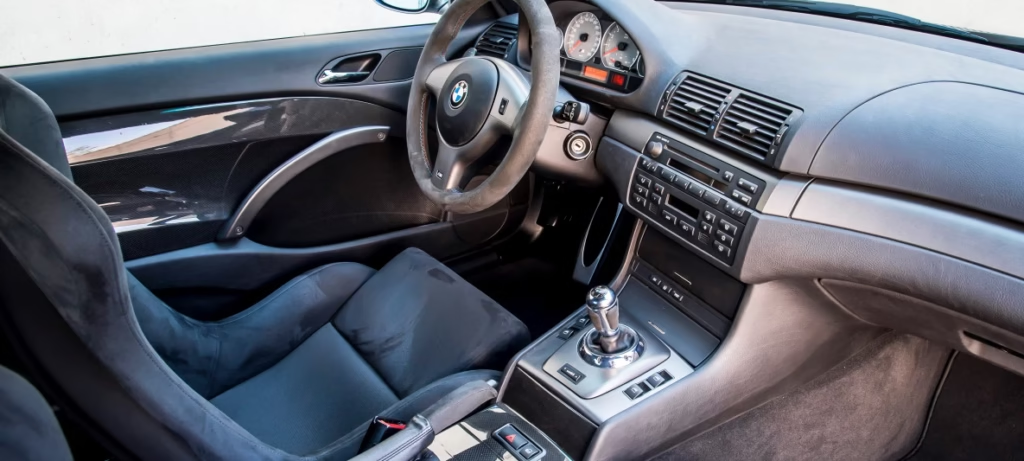
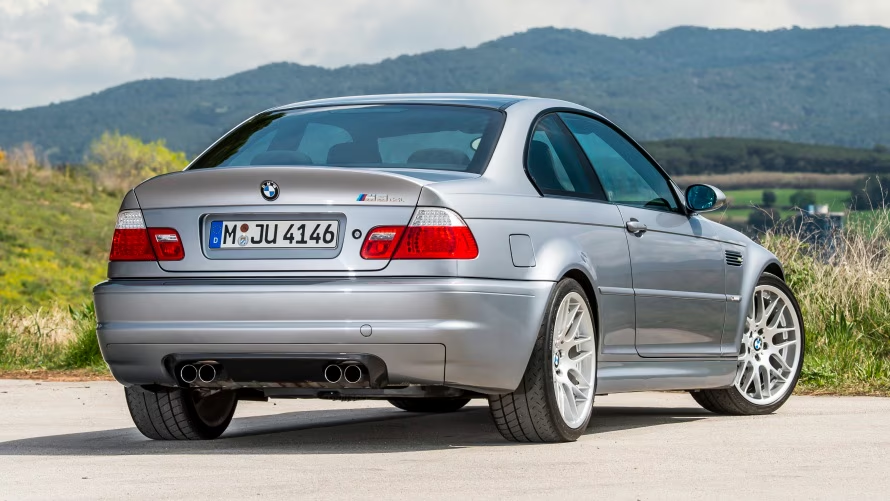
- Motorsport Composites: The front apron, rear diffuser, and interior door panels were crafted from carbon fiber.
- Thin-Glass Technology: The rear window was made of special, extra-thin glass.
- Stripped Interior: The cabin was a lesson in purism. It featured lightweight fiberglass-backed bucket seats, and buyers truly dedicated to track performance could delete the radio and climate control entirely from the factory.
The S54B32HP: The Sound of Naturally Aspirated Perfection
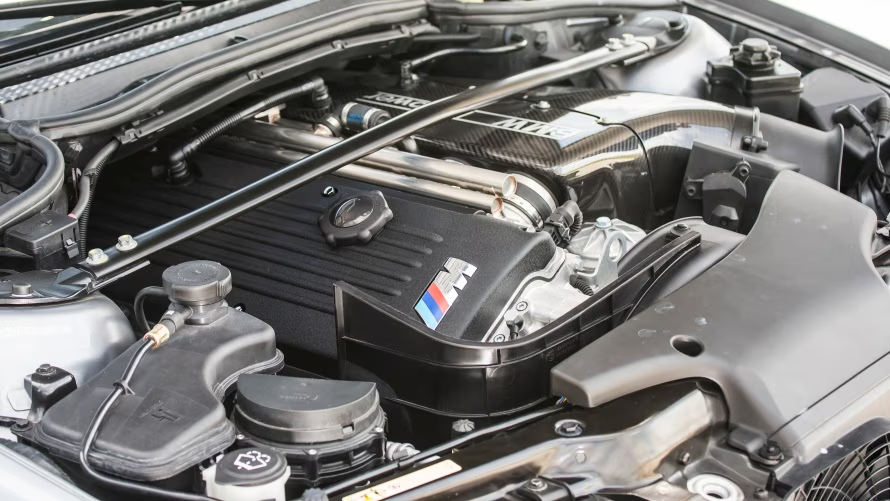
Under the aluminum hood, the legendary 3.2-liter inline-six was heavily revised, earning the new internal code S54B32HP (High-Performance).
Through the use of more aggressive camshafts, modified exhaust valves, and a completely reprogrammed ECU, power was bumped to 360 horsepower and 370 Nm of torque. But the absolute defining characteristic of the CSL engine is its Carbon Fiber Airbox.
This massive, ultra-lightweight carbon intake plenum replaced the standard plastic manifold. Coupled with a unique ‘porthole’ air intake on the front bumper—which fed fresh oxygen directly into the engine—the carbon airbox gave the CSL an incredibly loud, metallic, and resonant intake roar that is widely considered one of the greatest mechanical sounds in automotive history.
Razor-Sharp Dynamics: The SMG II and Semi-Slicks
To ensure lightning-fast gear changes on the track, the CSL was offered exclusively with the electro-hydraulic SMG II transmission with Drivelogic, reprogrammed to shift even faster and more aggressively than in the standard M3.
The chassis was entirely re-engineered for the circuit. The CSL featured a wider front track, specifically tuned shorter springs, thicker anti-roll bars, and altered camber settings. It sat on bespoke, lightweight 19-inch forged alloy wheels wrapped in aggressive Michelin Pilot Sport Cup semi-slick tires straight from the factory.
Lord of the Ring
The result of this obsessive engineering was a power-to-weight ratio of just 3.85 kg/hp. The M3 CSL could sprint from 0 to 100 km/h (62 mph) in a blistering 4.9 seconds.
But straight-line speed wasn’t the point. The CSL was built for corners. In the hands of a skilled driver, it decimated the legendary 21-kilometer Nürburgring Nordschleife in 7 minutes and 50 seconds (7:50 min). In the early 2000s, this lap time shattered the egos of supercar manufacturers, proving that a perfectly balanced, lightweight chassis could outrun much more powerful opponents.
For buyers who held a valid “C” racing license, BMW would even remove the electronic speed limiter, raising the top speed from 250 km/h to 280 km/h (174 mph). The CSL wasn’t just a car; it was a street-legal race car that defined a generation.